
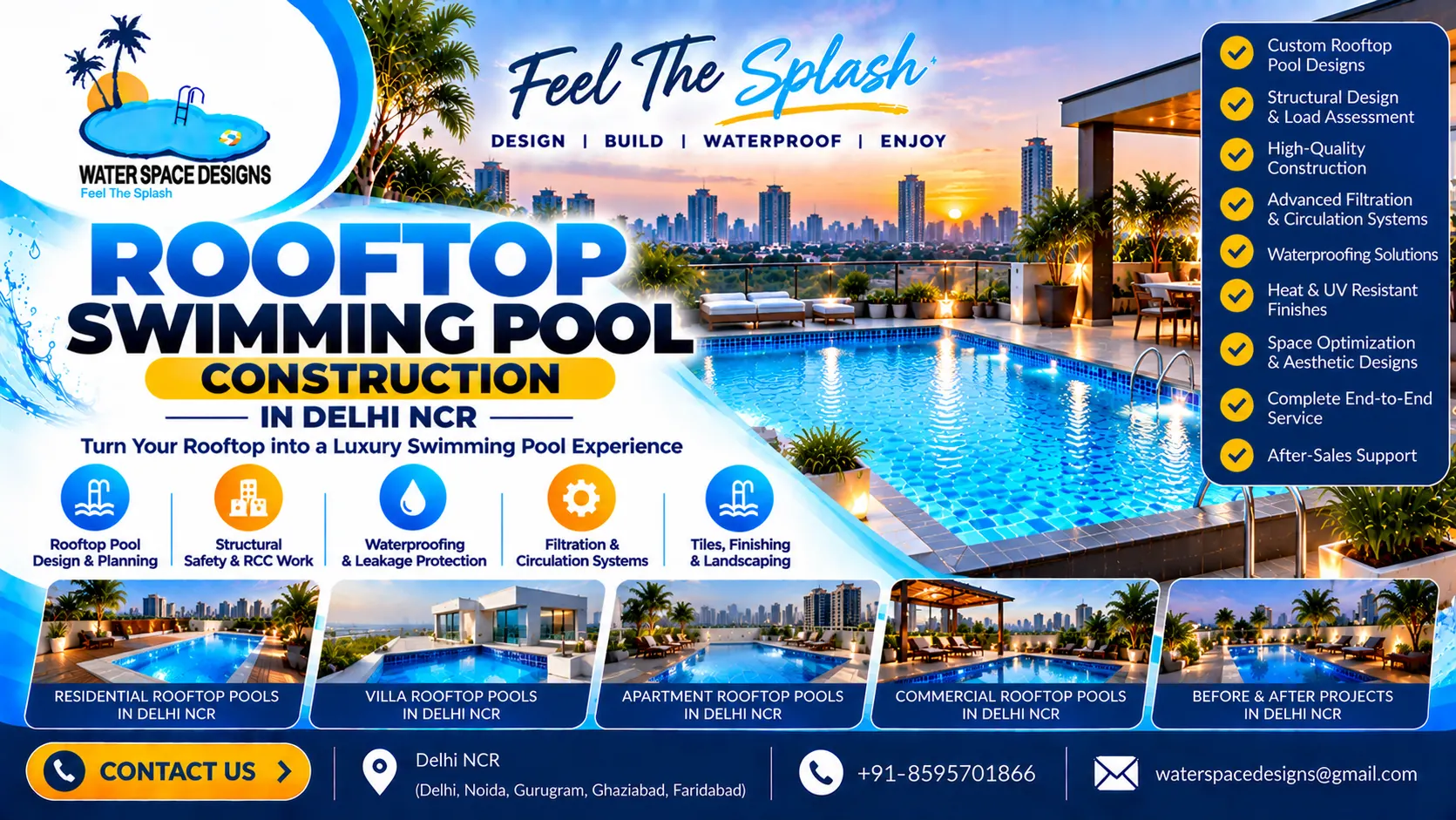
A rooftop swimming pool can transform an unused terrace into a private recreational space, luxury amenity or commercial attraction. However, a rooftop pool is fundamentally different from a conventional ground-level swimming pool.
The project must account for the existing building structure, additional water load, pool construction weight, waterproofing, drainage, plumbing, equipment, access and safety before construction begins.
Water Space Designs provides customized rooftop swimming pool construction in Delhi NCR for residential properties, villas, penthouses, farmhouses, hotels, clubs, commercial buildings and other suitable structures.
Rooftop pool construction specialists in the Delhi NCR market commonly emphasize structural assessment, waterproofing, hydraulic planning and complete turnkey coordination because the pool is being installed on an existing or elevated structure.
Can a Swimming Pool Be Built on a Rooftop?
A rooftop swimming pool may be possible, but not every building or terrace is suitable for one.
Before construction, the existing structure should be evaluated by an appropriately qualified structural professional.
The assessment may consider:
- Existing RCC slab
- Beams
- Columns
- Foundation
- Structural layout
- Existing building loads
- Proposed pool dimensions
- Water depth
- Pool construction weight
- Equipment weight
- Pool-deck load
- Wind exposure
- Access requirements
- Drainage
- Existing waterproofing
A structural assessment should be completed before committing to pool construction. Delhi NCR rooftop-pool construction sources similarly identify structural/load assessment as a fundamental first step.
Why Rooftop Pool Construction Requires Special Planning
A ground-level swimming pool transfers its loads to the ground through its foundation and supporting structure.
A rooftop pool transfers its loads through the existing building.
That difference makes several factors especially important:
Structural Load
Water is heavy, and the total rooftop load includes more than the water itself.
The project may also include:
- Pool shell
- Reinforcement
- Waterproofing
- Tiles
- Coping
- Pool deck
- Filtration equipment
- Pumps
- Balance tank
- Plant-room equipment
- People using the pool
The structural engineer should evaluate the combined load rather than considering water weight alone.
Waterproofing
A rooftop pool is directly above occupied or usable building space in many projects.
A waterproofing failure can therefore affect:
- Bedrooms
- Living areas
- Hotel rooms
- Offices
- Restaurants
- Club facilities
- Electrical installations
Pool waterproofing and building-roof waterproofing should be planned as coordinated systems.
Drainage
The rooftop must safely manage:
- Rainwater
- Pool overflow
- Backwash water
- Maintenance discharge
- Accidental water release
Drainage paths should be designed before construction rather than added later.
Lightweight Rooftop Swimming Pools
Where structurally appropriate, lightweight pool construction systems can reduce the additional dead load compared with some conventional heavy construction approaches.
Possible systems may include:
- FRP pool shells
- Lightweight composite systems
- Specialized panel systems
- Lightweight steel-supported pool systems
- Engineered membrane systems
The appropriate solution depends on the building structure and project design.
Lightweight systems are increasingly marketed for rooftop applications because reducing structural demand can be advantageous, but the final system should always be selected through engineering assessment rather than simply choosing the lightest product.
RCC Rooftop Swimming Pool Construction
An RCC rooftop pool can be considered when the existing building structure and engineering design support the proposed loads.
The project may involve:
- Structural assessment
- Pool design
- Load calculations
- Reinforcement planning
- RCC pool shell
- Plumbing
- Waterproofing
- Internal finishing
- Filtration
- Drainage
- Equipment installation
RCC construction can provide flexibility in pool dimensions and shape but may create substantial additional structural load compared with some lightweight systems.
FRP Rooftop Swimming Pool
FRP or fiberglass pool systems can be considered for selected rooftop projects where the objective is to reduce construction weight and installation complexity.
Potential advantages may include:
- Factory-produced shell
- Reduced on-site wet construction
- Faster installation in suitable projects
- Consistent shell manufacturing
- Lightweight construction compared with some conventional systems
However, the complete installed weight still includes water, support structure, equipment, deck and users.
Therefore, an FRP pool should not be treated as automatically suitable for every roof.
Rooftop Plunge Pool
A plunge pool can be a practical option where the available rooftop area or structural capacity does not support a large swimming pool.
A plunge pool may provide:
- Compact footprint
- Reduced water volume
- Private relaxation area
- Cooling space
- Luxury rooftop feature
The depth, dimensions and total load still need structural evaluation.
Rooftop Infinity Pool Construction
Infinity-edge rooftop pools can create a strong architectural effect, particularly for:
- Luxury villas
- Penthouses
- Boutique hotels
- Resorts
- High-rise properties
The design requires additional planning for:
- Infinity edge
- Overflow channel
- Balance/surge tank
- Water circulation
- Structural edge
- Waterproofing
- Drainage
- Pool equipment
An infinity edge should be incorporated during initial structural and architectural planning.
Rooftop Swimming Pool for Villas and Penthouses
A private rooftop pool can be integrated with a villa or penthouse terrace.
Design options may include:
- Compact pool
- Plunge pool
- Infinity pool
- Lap-style pool
- Spa combination
- Pool with sun deck
- Poolside seating
- Landscape elements
- Outdoor shower
The pool should be designed around the building’s structure and the owner’s lifestyle rather than using a standard design.
Rooftop Swimming Pool for Hotels
Hotel rooftop pools require both architectural and operational planning.
Potential applications include:
- Luxury hotels
- Boutique hotels
- Business hotels
- Rooftop lounges
- Resorts
- Hospitality properties
Commercial rooftop pools may require:
- Higher-capacity filtration
- Larger circulation systems
- Overflow management
- Guest safety systems
- Plant-room access
- Maintenance areas
- Deck drainage
- Additional structural coordination
A Gurgaon hotel project, for example, has documented the specific waterproofing concerns involved in placing a rooftop pool above occupied hotel rooms, illustrating why waterproofing needs to be addressed as a major design consideration.
Rooftop Swimming Pool for Clubhouses and Residential Societies
Rooftop pools can also be planned for:
- Apartment clubhouses
- Residential societies
- High-rise developments
- Corporate campuses
- Fitness centres
- Premium housing projects
These projects need to consider expected user capacity, filtration, changing facilities, safety, maintenance access and operating requirements.
Rooftop Pool Structural Assessment
Structural assessment should be one of the first stages of a rooftop pool project.
The assessment can consider:
Existing Structure
- Slab thickness
- Beam arrangement
- Column locations
- Foundation system
- Existing structural drawings
- Building age
- Existing modifications
Proposed Pool
- Pool dimensions
- Water depth
- Water volume
- Pool shell weight
- Reinforcement
- Equipment
- Deck
- User load
Other Loads
- Existing water tanks
- Solar panels
- HVAC equipment
- Landscape
- Seating
- Parapets
- Other rooftop installations
The final decision about structural suitability should be made by a qualified structural engineer.
Rooftop Pool Waterproofing
Waterproofing is one of the most critical components of elevated pool construction.
Potential leakage locations include:
- Pool shell
- Construction joints
- Expansion joints
- Pipe penetrations
- Pool corners
- Main drains
- Skimmers
- Overflow channels
- Balance tanks
- Equipment-room connections
- Pool-deck transitions
Depending on the system, waterproofing may involve:
- Cementitious waterproofing
- PU systems
- Liquid membranes
- Reinforced PVC membranes
- Waterproof concrete systems
- Joint sealants
- Protective layers
The selected system should be compatible with the pool structure and final finish.
Double-Layer Waterproofing Approach
For certain rooftop projects, multiple waterproofing and drainage protections may be considered.
A system can potentially include:
- Structural pool shell
- Primary waterproofing
- Protection layer
- Drainage or inspection provision where designed
- Final pool finish
The exact configuration depends on the structural and waterproofing design.
The goal is to avoid relying on a single surface coating as the only protection against water movement.
Rooftop Pool Drainage System
Drainage is particularly important on rooftops because uncontrolled water can affect the building below.
A rooftop pool project may require planning for:
- Pool overflow
- Terrace rainwater
- Pool-deck drains
- Equipment-room drainage
- Filter backwash
- Maintenance discharge
- Emergency drainage
Drainage should have adequate capacity and clearly defined discharge routes.
Rooftop Pool Filtration System
The filtration system should be sized according to:
- Pool volume
- Expected usage
- Turnover requirement
- Pool type
- Overflow/skimmer system
- Water features
Typical equipment can include:
- Pool pump
- Sand/media filter
- Cartridge filter
- Skimmers
- Return inlets
- Main drains
- Balance/surge tank
- Chemical dosing
- Control panel
A compact and accessible plant-room design is especially useful for rooftop installations.
Rooftop Pool Plumbing
Rooftop plumbing requires careful coordination because pipe routes must work with the existing building.
The design may include:
- Suction lines
- Return lines
- Overflow lines
- Drainage
- Skimmer lines
- Balance-tank connections
- Water-feature lines
- Backwash lines
- Make-up water supply
Pipe penetrations through the existing roof or pool structure should receive suitable waterproofing detailing.
Rooftop Pool Electrical Planning
Electrical planning should account for:
- Pool pumps
- Filtration equipment
- Underwater lights
- Control panels
- Chemical dosing
- Heating equipment
- Landscape lighting
- Water features
Electrical work around pools requires appropriate protection and professional installation according to applicable requirements.
Rooftop Swimming Pool Safety
Safety should be integrated into the design.
Depending on the project, considerations may include:
- Non-slip pool deck
- Safe entry steps
- Handrails
- Suitable pool depth
- Edge protection
- Guardrails
- Safe access
- Emergency access
- Adequate lighting
- Drain protection
- Electrical safety
Commercial and high-rise projects may require additional safety planning based on applicable local requirements.
Rooftop Pool Construction Process
Step 1: Initial Consultation
The intended pool type, approximate dimensions, usage and property details are discussed.
Step 2: Site Inspection
The existing rooftop, access, services, drainage and available area are assessed.
Step 3: Structural Feasibility
A qualified structural professional evaluates whether the proposed pool concept is feasible for the existing building.
Step 4: Pool Design
The pool shape, depth, circulation and architectural elements are developed.
Step 5: Engineering Coordination
Structural, waterproofing, plumbing, electrical and drainage requirements are coordinated.
Step 6: Construction System Selection
Depending on the project, an RCC, FRP, composite, membrane or other engineered system may be selected.
Step 7: Installation/Construction
The pool shell or structure is installed according to the approved design.
Step 8: Plumbing and Filtration
Pumps, filters, drains, return lines and related equipment are installed.
Step 9: Waterproofing
The specified waterproofing system is applied and detailed at critical locations.
Step 10: Finishing
Tiles, coping, deck surfaces, lighting and other finishes are completed.
Step 11: Testing
Water-retention, plumbing, drainage and equipment systems are checked before commissioning.
Step 12: Commissioning
The pool is filled, filtration is operated and the completed system is handed over after inspection.
Rooftop Pool Water Testing
Before final handover, testing may include:
- Plumbing pressure checks
- Drainage checks
- Equipment testing
- Waterproofing inspection
- Water-retention testing
- Overflow testing
- Filtration testing
A controlled testing process can help identify problems before the pool enters regular use.
Rooftop Pool Cost in Delhi NCR
There is no single fixed price for rooftop swimming pool construction.
Rooftop projects can cost more than comparable ground-level pools because of additional engineering, access, structural work, waterproofing and specialized construction requirements.
Important cost factors include:
- Pool dimensions
- Water depth
- Existing building structure
- Structural strengthening
- Pool construction system
- RCC/FRP/composite materials
- Waterproofing
- Filtration
- Plumbing
- Plant room
- Drainage
- Pool tiles
- Coping
- Pool deck
- Lighting
- Heating
- Water features
- Crane or lifting requirements
- Site accessibility
- Structural consultant fees
Published Delhi NCR pool-construction sources currently show indicative turnkey pool rates in the broad range of roughly ₹2,046–₹3,968 per sq ft for conventional construction, but rooftop projects can differ substantially because structural and access requirements are project-specific. This should be treated only as a market reference, not as Water Space Designs’ quotation.
A proper quotation should be prepared only after assessing the property and final pool specification.
Rooftop Swimming Pool Construction Timeline
The timeline depends on:
- Structural assessment
- Design approval
- Building modifications
- Pool construction system
- Material availability
- Waterproofing
- Plumbing
- Filtration
- Finishing
- Testing
- Site access
A rooftop project may require more planning time than a simple ground-level pool because structural feasibility and coordination need to be completed before construction.
Rooftop Pool Access and Material Handling
Access is an important practical issue in rooftop construction.
The project may need to consider:
- Staircase dimensions
- Lift capacity
- Material movement
- Roof access
- Crane requirements
- FRP shell lifting
- Equipment movement
- Construction debris removal
A lightweight or modular system can sometimes simplify access, but this depends on the individual project.
Rooftop Pool Vibration and Equipment Placement
Pumps and filtration equipment can create vibration and noise.
Therefore, the plant room should be planned to:
- Isolate equipment where appropriate
- Reduce transmission of vibration
- Maintain service access
- Protect equipment from weather
- Keep plumbing routes efficient
- Minimize disturbance to occupants
High-rise rooftop-pool systems in the market specifically incorporate vibration isolation and compact mechanical-room planning as part of elevated pool engineering.
Rooftop Swimming Pool for Delhi NCR Climate
Delhi NCR experiences hot summers, monsoon rainfall and cool winters.
A rooftop pool therefore needs to account for:
- Strong solar exposure
- Thermal expansion
- Rainwater
- UV exposure
- Winter temperature
- Waterproofing durability
- Drainage
- Pool equipment protection
Pool heating may also be considered where year-round use is desired.
Rooftop Swimming Pool Maintenance
Maintenance should be planned from the beginning.
Regular maintenance may include:
- Water-quality testing
- pH management
- Sanitisation
- Filter cleaning
- Pump inspection
- Skimmer cleaning
- Tile inspection
- Waterproofing inspection
- Drain cleaning
- Overflow inspection
- Equipment maintenance
Rooftop pools should also receive periodic inspection of the surrounding roof and drainage system.
How to Choose a Rooftop Swimming Pool Contractor in Delhi NCR
Before selecting a contractor, ask:
- Will the existing building be structurally assessed?
- Who is responsible for structural engineering?
- What pool construction system is proposed?
- What is the estimated total installed load?
- How will waterproofing be designed?
- How will drainage be managed?
- Where will the filtration plant be located?
- How will equipment reach the rooftop?
- What waterproofing testing is included?
- How will pipe penetrations be treated?
- What safety measures are included?
- What is included and excluded from the quotation?
- Who coordinates civil, structural and MEP work?
- What maintenance access will be provided?
These questions can help property owners compare proposals based on technical scope rather than price alone.
Why Choose Water Space Designs?
Water Space Designs approaches rooftop swimming pool construction as a coordinated architectural, structural and waterproofing project.
Services can include:
- Rooftop pool design
- Structural coordination
- Custom pool construction
- Lightweight pool solutions
- RCC pool construction
- FRP pool solutions
- Pool waterproofing
- Plumbing
- Filtration
- Drainage
- Pool lighting
- Pool heating
- Water features
- Pool finishing
- Pool renovation
The actual construction system should be selected according to the building structure and engineering requirements.
Rooftop Swimming Pool Construction Across Delhi NCR
Water Space Designs can target rooftop swimming pool projects across:
Delhi
- South Delhi
- New Delhi
- Dwarka
- Rohini
- Pitampura
- Vasant Kunj
- Chattarpur
- Greater Kailash
- Saket
- Defence Colony
- Shalimar Bagh
Noida
- Noida sectors
- Sector 15
- Sector 27
- Sector 44
- Sector 50
- Sector 62
- Sector 75
- Sector 78
- Sector 93
- Sector 100
- Sector 137
- Sector 150
Greater Noida
- Greater Noida West
- Techzone
- Noida Extension
- Sector 1
- Sector 10
- Sector 12
- Sector 16
- Sector 18
- Sector 20
Gurugram
- Golf Course Road
- Golf Course Extension Road
- DLF Phase 1–5
- Sohna Road
- Sector 49
- Sector 50
- Sector 56
- Sector 65
- Sector 66
- Sector 67
- New Gurgaon
- Manesar
Ghaziabad
- Indirapuram
- Vaishali
- Vasundhara
- Raj Nagar
- Raj Nagar Extension
- Crossings Republik
- Siddharth Vihar
- Wave City
- Kaushambi
- Sahibabad
Faridabad
- Sector 14
- Sector 15
- Sector 16
- Sector 21
- Sector 28
- Sector 37
- Sector 41
- Greenfield Colony
- Surajkund
- Neharpar
- Greater Faridabad
Actual project feasibility and service availability should be confirmed for the specific property.
Frequently Asked Questions
Can a swimming pool be built on a rooftop?
A rooftop swimming pool may be possible if the existing building structure can safely support the additional loads. A structural assessment should be completed before construction.
Is a rooftop swimming pool safe?
Safety depends on proper structural engineering, waterproofing, drainage, construction and equipment installation. A rooftop pool should not be considered safe simply because a lightweight system is being used.
How much does a rooftop swimming pool cost in Delhi NCR?
The cost depends on pool size, depth, structural modifications, construction system, waterproofing, filtration, finishing, access and equipment. Rooftop projects can have additional engineering and installation costs compared with ground-level pools.
Which is better for a rooftop pool, RCC or FRP?
Neither is universally better. RCC provides design flexibility but can add substantial structural load. FRP and other lightweight systems may reduce construction weight, but the complete installed system still needs structural evaluation.
What is the biggest concern with rooftop swimming pools?
Structural load and water management are two of the most important concerns. Waterproofing, drainage, access, equipment and safety must also be properly engineered.
How deep should a rooftop swimming pool be?
There is no universal depth. Pool depth should be selected according to intended use and structural feasibility. Reducing depth can reduce water load, but the overall design still needs engineering review.
Can an existing house have a rooftop pool?
Possibly, but the existing building must first be assessed. Older buildings or buildings without adequate structural capacity may require strengthening or may not be suitable.
Can a rooftop pool be built on a flat RCC roof?
A flat RCC roof may be suitable for some rooftop pool projects, but the existing slab, beams, columns and foundation must be assessed before construction.
Is waterproofing more important for a rooftop pool?
Waterproofing is always important for a swimming pool, but rooftop pools have additional consequences because leakage can affect occupied areas beneath the pool.
Can a rooftop swimming pool have an infinity edge?
Yes, where the building structure, site levels and engineering design permit it. Infinity pools require additional overflow, balance-tank, hydraulic and structural planning.
Can a rooftop pool be heated?
Yes. Pool heating can be incorporated depending on the pool size, usage season, available equipment space and energy requirements.