
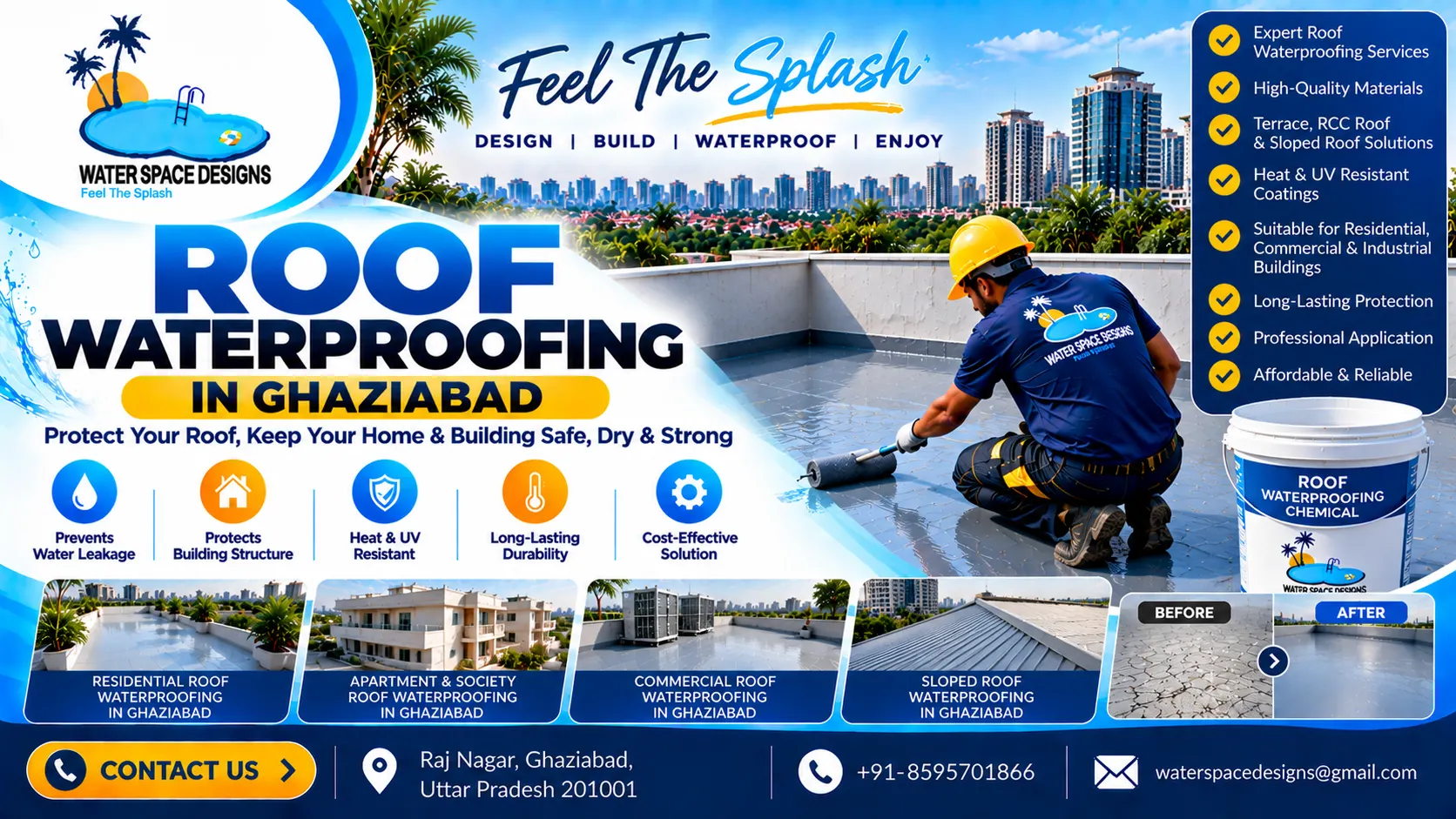
A roof is continuously exposed to sunlight, rain, temperature changes and moisture. Over time, cracks, failed joints, damaged waterproofing layers, blocked drainage and water ponding can allow moisture to penetrate the roof structure.
Water Space Designs provides roof waterproofing in Ghaziabad for residential, commercial and other properties, with solutions selected according to the roof type, surface condition, leakage source and intended use.
Roof waterproofing should not simply mean applying a coating over an existing surface. A proper solution may also require crack treatment, joint detailing, drainage correction, parapet treatment and suitable surface preparation.
Ghaziabad-focused waterproofing services commonly address roof leakage, terrace seepage, dampness and monsoon-related water penetration.
Why Roof Waterproofing Is Important in Ghaziabad
Ghaziabad roofs experience strong summer heat as well as seasonal rainfall. Repeated expansion and contraction, rainwater exposure and inadequate drainage can contribute to surface deterioration and leakage.
Untreated roof leakage may lead to:
- Damp ceilings
- Peeling paint
- Plaster deterioration
- Wall seepage
- Mould or dampness
- Efflorescence
- Cracked surfaces
- Corrosion-related concerns where moisture reaches reinforcement
- Damage to false ceilings
- Leakage around electrical or service areas
Waterproofing should ideally be considered when early signs of leakage appear rather than waiting for extensive interior damage.
Roof Leakage Repair in Ghaziabad
Roof leakage can originate from different locations, including:
- RCC roof cracks
- Parapet-wall junctions
- Drain outlets
- Pipe penetrations
- Construction joints
- Expansion joints
- Damaged waterproofing
- Water ponding areas
- Roof-mounted equipment
- Poor surface slope
The first step should be identifying the likely water-entry route.
Applying a new coating without addressing the underlying cause can result in repeated leakage.
RCC Roof Waterproofing in Ghaziabad
RCC roofs are common in residential and commercial buildings.
A suitable RCC roof waterproofing project may involve:
- Roof inspection
- Surface cleaning
- Identification of cracks and joints
- Repair of damaged areas
- Drainage inspection
- Surface preparation
- Primer or bonding treatment where required
- Waterproofing application
- Parapet and penetration detailing
- Protective finishing where required
- Final inspection
The exact treatment depends on the existing RCC surface and the selected waterproofing system.
Flat Roof Waterproofing in Ghaziabad
Flat roofs require careful attention to drainage because rainwater may remain on the surface if the slope or outlets are inadequate.
Important considerations include:
- Roof slope
- Drainage outlets
- Surface condition
- Ponding areas
- Parapet walls
- Pipe penetrations
- Existing waterproofing
- Expansion joints
- Roof access
Waterproofing alone may not solve persistent ponding if the drainage problem remains unresolved.
Roof Crack Repair and Waterproofing
Cracks can provide pathways for water to enter the roof structure.
The appropriate repair depends on:
- Crack width
- Crack depth
- Crack location
- Whether the crack is active
- Substrate condition
- Structural significance
Not every crack should be treated in the same manner.
Minor surface cracks may require suitable filling and sealing, while cracks that appear structurally significant may require appropriate engineering assessment before waterproofing.
Parapet Wall Waterproofing
The roof-to-parapet junction is an important waterproofing detail.
Water can enter where:
- The roof and parapet meet
- Plaster has cracked
- Existing waterproofing has terminated incorrectly
- Coping has deteriorated
- Joints have opened
A roof waterproofing system should include appropriate detailing at these transition areas instead of treating only the central roof surface.
Roof Drainage and Water Ponding
Water ponding is one of the issues that can reduce the effectiveness and service life of roof waterproofing.
Possible causes include:
- Insufficient slope
- Blocked outlets
- Damaged drains
- Uneven screed
- Settlement
- Incorrect previous repairs
- Poorly positioned rainwater outlets
Before waterproofing, drainage should be inspected.
Where necessary, corrective work may include drain cleaning, local slope correction, outlet repair or surface regrading.
Roof Waterproofing for New Construction
Waterproofing should be planned during new construction rather than added only after leakage occurs.
New roof waterproofing planning should consider:
- RCC surface
- Roof slope
- Drainage
- Parapet detailing
- Construction joints
- Pipe penetrations
- Waterproofing compatibility
- Protective screed
- Final roof finish
Early coordination between civil, plumbing and waterproofing work can help avoid detailing conflicts.
Roof Waterproofing for Old Buildings
Older roofs may have multiple layers of previous repairs.
Typical problems include:
- Deteriorated waterproofing
- Cracked screed
- Loose tiles
- Blocked drains
- Ponding
- Failed joints
- Damp ceilings
- Repeated patch repairs
An inspection can determine whether the existing system should be repaired, overlaid or removed before a new waterproofing system is installed.
Roof Waterproofing Methods in Ghaziabad
Different roofs require different systems.
Polymer-Based Waterproofing
Polymer-modified systems can be used for suitable roof applications where flexibility and adhesion are required.
Liquid Waterproofing Membrane
Liquid-applied waterproofing can create a continuous membrane when applied over a properly prepared substrate.
It can be useful around complex roof details where a continuous coating is appropriate.
PU Waterproofing
Polyurethane systems may be considered where flexibility and crack-bridging characteristics are required.
Substrate moisture, surface preparation and product specifications should be checked before application.
APP / Bituminous Membrane
Bituminous membrane systems can be suitable for specific roof applications.
Proper detailing around:
- Drains
- Parapets
- Joints
- Pipe penetrations
- Corners
is important for system performance.
Cementitious Waterproofing
Cementitious waterproofing may be suitable for selected substrates and applications. The product and application method should be chosen according to the roof condition and manufacturer’s requirements.
Chemical Roof Waterproofing in Ghaziabad
Chemical waterproofing can refer to several different material technologies rather than one universal treatment.
Depending on the project, chemical systems may include:
- Polymer-modified coatings
- Acrylic/elastomeric coatings
- PU systems
- Cementitious waterproofing
- Sealants
- Crack-filling compounds
The material should be selected based on the roof surface, exposure, movement, leakage condition and final finish.
Roof Waterproofing for Residential Buildings
Water Space Designs can provide roof waterproofing solutions for:
- Independent houses
- Builder floors
- Villas
- Apartments
- Residential societies
- Farmhouses
- Multi-storey homes
For residential roofs, waterproofing can help protect rooms located directly beneath the roof from dampness and leakage.
Roof Waterproofing for Commercial Buildings
Commercial roofs may have:
- HVAC equipment
- Solar panels
- Water tanks
- Service pipes
- Electrical installations
- Maintenance walkways
- Multiple drainage outlets
The waterproofing system should therefore be planned around existing rooftop services rather than treating the roof as an empty surface.
Industrial Roof Waterproofing
Industrial and warehouse roofs can have larger surface areas and different substrates.
The waterproofing approach may depend on whether the roof is:
- RCC
- Metal sheet
- Concrete
- Existing membrane
- Coated surface
Industrial roofs may also require consideration of equipment, maintenance traffic, drainage and thermal exposure.
Roof Waterproofing Around Solar Panels
Solar installations can introduce mounting points, cable routes and maintenance access requirements.
Before waterproofing or installing rooftop solar equipment, it is important to consider:
- Existing waterproofing
- Mounting locations
- Cable penetrations
- Drainage
- Maintenance paths
- Equipment supports
Any penetration through a waterproofing layer should receive appropriate detailing.
Roof Waterproofing Process in Ghaziabad
Step 1: Roof Inspection
The roof is inspected for leakage, cracks, dampness, ponding and damaged waterproofing.
Step 2: Leakage Diagnosis
Potential water-entry locations are identified.
Step 3: Surface Preparation
Loose material, dirt, damaged coating and unsuitable areas are removed or prepared according to the selected system.
Step 4: Crack and Joint Treatment
Relevant cracks, joints and vulnerable transitions are treated.
Step 5: Drainage Assessment
Drain outlets and water flow are checked.
Step 6: Waterproofing Application
The specified waterproofing system is applied according to its technical requirements.
Step 7: Detail Treatment
Parapets, corners, pipe penetrations and drainage points receive appropriate detailing.
Step 8: Protective Finish
Where required, a suitable protective layer or final finish is installed.
Step 9: Final Inspection
The completed roof is checked for continuity, detailing and drainage.
Roof Waterproofing Before Monsoon
Pre-monsoon roof inspection can help identify problems before heavy rainfall.
Property owners should check:
- Roof cracks
- Drain outlets
- Parapet joints
- Pipe penetrations
- Old waterproofing
- Water ponding
- Damaged screed
- Dampness on ceilings
- Previous repair areas
Ghaziabad waterproofing providers specifically position roof and terrace waterproofing as protection against seasonal rainfall and leakage.
Roof Waterproofing and Heat Protection
A roof waterproofing project may also be coordinated with suitable heat-reflective or insulation measures where required.
This can be relevant for roofs that experience:
- Strong summer sunlight
- High surface temperatures
- Poor thermal insulation
- Extensive exposed RCC surfaces
However, waterproofing and thermal insulation are different functions. The appropriate solution should be selected according to the property’s requirements.
Roof Waterproofing Cost in Ghaziabad
Roof waterproofing cost depends on the actual project scope.
Factors can include:
- Roof area
- Roof condition
- Existing waterproofing
- Crack repair
- Surface preparation
- Drainage correction
- Waterproofing system
- Number of layers
- Parapet treatment
- Protective screed
- Tile removal
- Accessibility
- Labour
- Final roof finish
Published Delhi NCR market references currently show different indicative ranges depending on the treatment. One provider lists approximately ₹45–₹75 per sq ft for basic coating, ₹55–₹75 for an elastomeric membrane and ₹60–₹120 for APP membrane work, while explicitly noting that actual pricing varies by site conditions and material.
These are market references only, not Water Space Designs’ fixed prices.
A site inspection is preferable before preparing a final quotation.
How Long Does Roof Waterproofing Take?
The duration depends on:
- Roof size
- Surface preparation
- Existing coating
- Crack repairs
- Waterproofing system
- Number of layers
- Drying/curing requirements
- Weather
- Protective finishing
A small localized repair may take considerably less time than complete roof rehabilitation.
The actual schedule should be confirmed after inspection.
How to Choose a Roof Waterproofing Contractor in Ghaziabad
Before selecting a contractor, ask:
- Will the roof be inspected before quotation?
- Will the source of leakage be investigated?
- What waterproofing system is being proposed?
- Why is that system suitable for the roof?
- How will cracks be treated?
- How will parapet joints be waterproofed?
- How will drain outlets be handled?
- Are pipe penetrations included?
- Is surface preparation included?
- Is the old waterproofing being removed or retained?
- What protective finish is included?
- Is the scope of work provided in writing?
This helps compare contractors on technical scope instead of price alone.
Why Choose Water Space Designs for Roof Waterproofing?
Water Space Designs focuses on condition-based roof waterproofing rather than applying one standard solution to every building.
Our approach includes:
- Roof inspection
- Leakage-source assessment
- RCC roof waterproofing
- Crack and joint treatment
- Drainage assessment
- Parapet detailing
- Pipe penetration treatment
- New construction waterproofing
- Old roof repair
- Residential roof waterproofing
- Commercial roof waterproofing
- Customized material selection
- Maintenance-oriented planning
The recommended system should be based on the actual roof condition and intended use.
Roof Waterproofing Areas in Ghaziabad
Water Space Designs can target roof waterproofing requirements across Ghaziabad, including:
- Raj Nagar
- Raj Nagar Extension
- Indirapuram
- Vaishali
- Vasundhara
- Kaushambi
- Sahibabad
- Mohan Nagar
- Shalimar Garden
- Rajendra Nagar
- Kavi Nagar
- Shastri Nagar
- Govindpuram
- Pratap Vihar
- Siddharth Vihar
- Crossings Republik
- Vijay Nagar
- Loni
- Dasna
- Lal Kuan
- NH-9 / NH-24 corridor
- Wave City
- Delhi-Ghaziabad border areas
Service availability should be confirmed according to the exact property location.
Frequently Asked Questions
What is roof waterproofing?
Roof waterproofing is the process of protecting a roof from water penetration using suitable waterproofing systems, crack and joint treatment, drainage correction and protective finishing where required.
What causes roof leakage in Ghaziabad?
Roof leakage can result from cracks, deteriorated waterproofing, water ponding, poor drainage, parapet joints, construction joints and leakage around pipes or drainage outlets.
Which waterproofing method is best for an RCC roof?
There is no single method suitable for every RCC roof. Polymer, liquid membrane, PU, bituminous and cementitious systems may be appropriate depending on the substrate, cracks, movement, moisture and intended use.
Can old roof waterproofing be repaired?
In many cases, yes. The existing waterproofing should first be inspected to determine whether repair, overlay or complete removal is appropriate.
Does waterproofing stop water ponding?
Not necessarily. If ponding is caused by inadequate slope or blocked drainage, the underlying drainage issue may need to be corrected as part of the project.
Can roof waterproofing be done before monsoon?
Yes. Pre-monsoon inspection and repair can help identify cracks, damaged waterproofing and drainage problems before heavy rainfall. Application also depends on suitable weather and product requirements.
Is roof waterproofing different from terrace waterproofing?
The terms are often used interchangeably, but search intent can differ. Roof waterproofing generally emphasizes protection of the roof structure from leakage, while terrace waterproofing may also focus on usable terraces, flooring, tiles, landscaping and terrace-specific finishes.
How much does roof waterproofing cost in Ghaziabad?
There is no universal price. The cost depends on roof area, surface condition, waterproofing system, crack repair, drainage work, accessibility and final finish. A site inspection provides a more accurate estimate.
Can waterproofing be applied over existing tiles?
Sometimes. The decision depends on tile condition, adhesion, drainage, moisture and compatibility with the proposed waterproofing system. The existing surface should be inspected first.
How can roof leakage be prevented?
Regularly inspect cracks, drainage outlets, parapet joints and pipe penetrations. Keeping roof drains clear and addressing small waterproofing failures early can help reduce the risk of extensive leakage.