
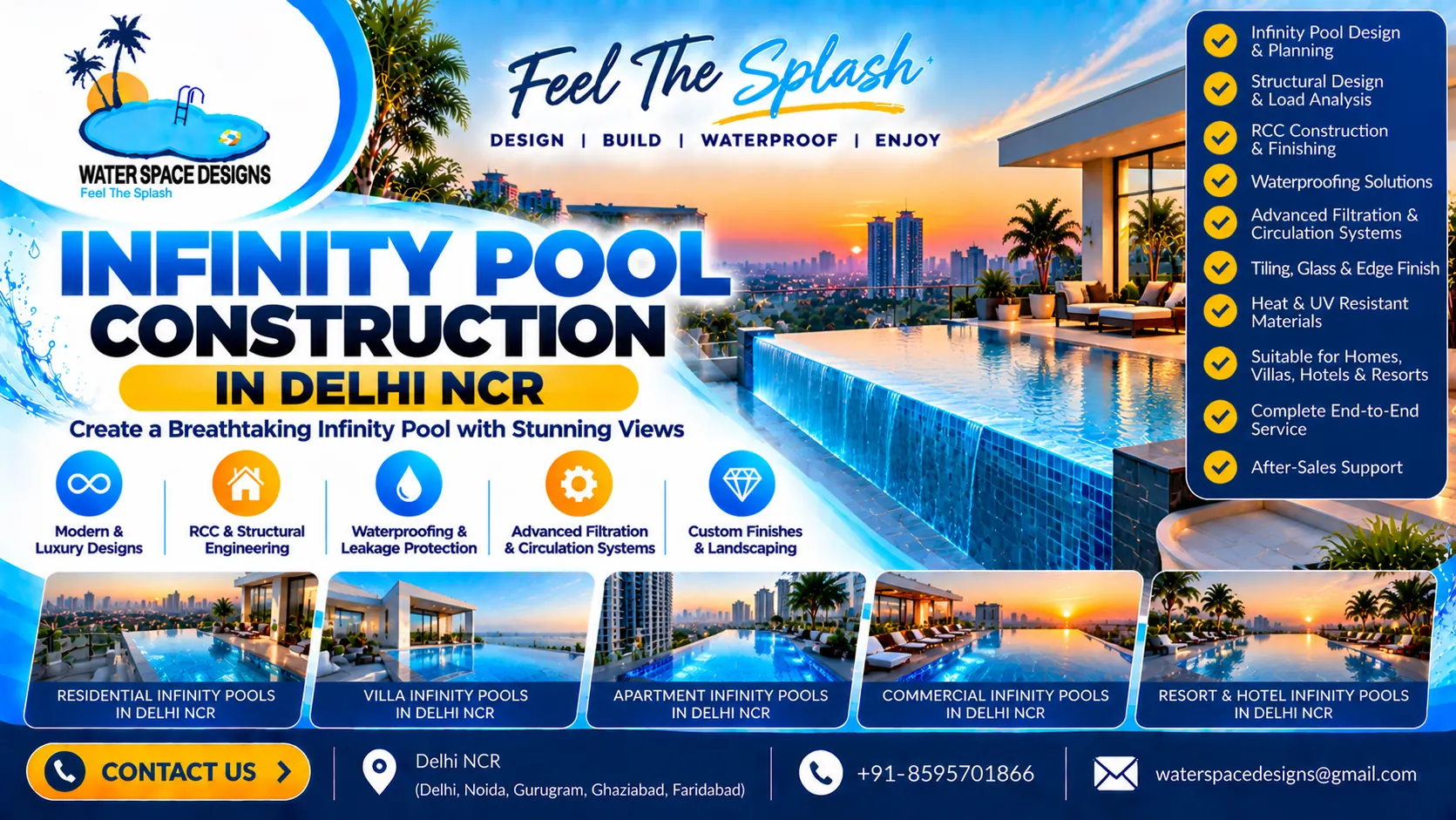
An infinity pool, also known as a vanishing-edge or negative-edge pool, is designed so that water flows over one or more edges into a hidden catch system. From the right viewing angle, the pool creates the visual impression that the water continues toward the horizon.
Water Space Designs provides custom infinity pool construction in Delhi NCR for villas, farmhouses, luxury homes, penthouses, hotels, resorts, clubs and selected commercial properties.
Unlike a conventional swimming pool, an infinity pool requires coordinated planning of the pool structure, overflow edge, catch basin, balance tank, circulation system, waterproofing, filtration and finishing.
Delhi NCR infinity-pool construction providers describe balancing-tank sizing, hydraulic circulation and accurate overflow-weir levels as important components of an effective infinity-edge system.
What Is an Infinity Pool?
An infinity pool is a swimming pool where water flows continuously over a specially designed edge.
The overflowing water is collected and returned to the main pool through a circulation system.
A typical system can include:
- Main pool
- Infinity edge/weir
- Catch basin or overflow channel
- Balance/surge tank
- Circulation pump
- Filtration system
- Return lines
- Automatic water-level control
- Waterproofing
- Pool finish
The visual effect is created by the relationship between the water level, infinity edge and surrounding view.
How Does an Infinity Pool Work?
The basic circulation process is:
Pool → Infinity Edge → Catch Basin → Balance Tank → Pump → Filter → Pool
The infinity edge allows water to overflow continuously.
The catch basin collects the overflowing water.
The balance tank accommodates changes in water volume caused by swimmers, evaporation and overflow conditions.
The circulation pump then sends the water through filtration and treatment before returning it to the pool.
A properly engineered system helps maintain a consistent water level and controlled overflow.
Infinity Pool vs Regular Swimming Pool
The primary difference is the water-circulation and edge design.
| Feature | Regular Pool | Infinity Pool |
|---|---|---|
| Water edge | Conventional edge | Overflow/vanishing edge |
| Catch basin | Usually not required | Required for infinity edge |
| Balance tank | Depending on design | Commonly required |
| Hydraulic design | Standard circulation | More complex |
| Structural detailing | Standard | More specialized |
| Visual effect | Conventional | Horizon/vanishing-edge effect |
| Cost | Generally lower | Generally higher |
| Maintenance | Standard | Additional overflow-system maintenance |
Infinity pools typically require more engineering and equipment than standard skimmer pools because of the additional overflow and recirculation system. Delhi NCR market references also show higher indicative pricing for overflow/infinity pools compared with basic pool construction.
Custom Infinity Pool Design in Delhi NCR
Every infinity pool should be designed around the property.
Important design considerations include:
- Pool dimensions
- Pool depth
- Infinity-edge location
- View direction
- Site elevation
- Pool shape
- Pool deck
- Landscape
- Balance tank location
- Equipment room
- Drainage
- Waterproofing
- Lighting
- Pool access
The infinity edge should ideally face the feature view, garden, landscape, city skyline or other visual focal point.
Infinity Pool for Villas
A villa infinity pool can become an architectural extension of the property.
Possible designs include:
- Backyard infinity pool
- Garden infinity pool
- Elevated infinity pool
- Courtyard infinity pool
- Pool connected to a villa terrace
- Compact infinity plunge pool
The pool can be coordinated with:
- Outdoor seating
- Pool deck
- Landscape
- Pergola
- Outdoor kitchen
- Lighting
- Water features
Infinity Pool for Farmhouses
Farmhouses provide greater opportunities for infinity-style pool designs because of their larger outdoor spaces and open views.
Possible applications include:
- Landscape-facing infinity pool
- Long family pool
- Resort-style pool
- Farmhouse plunge pool
- Infinity pool with deck
- Pool with waterfall feature
The surrounding landscape can be incorporated into the visual composition of the infinity edge.
Luxury Infinity Pool Construction
Luxury infinity pools can include additional architectural and technology features.
Depending on the project, options may include:
- Glass mosaic finish
- Premium coping
- Underwater LED lighting
- Automated filtration
- Automatic chemical dosing
- Pool heating
- Spa integration
- Waterfalls
- Deck jets
- Glass viewing panels
- Smart pool controls
- Landscape lighting
- Premium pool deck
The final specification should be based on the property’s architecture, budget and intended use.
Rooftop Infinity Pool Construction
A rooftop infinity pool requires additional structural planning because the pool is constructed above occupied or usable building space.
Before construction, the building should be evaluated for:
- RCC slab
- Beams
- Columns
- Foundation
- Existing loads
- Proposed pool water load
- Pool structure
- Equipment weight
- Pool deck
- User load
- Drainage
The infinity edge itself may also introduce additional structural and hydraulic requirements.
A rooftop infinity pool should therefore be treated as an engineered building project rather than a conventional terrace installation.
Infinity Pool for Penthouses
A penthouse can provide an excellent setting for a compact infinity or plunge pool where structural conditions permit.
Potential designs include:
- Compact infinity pool
- Rooftop plunge pool
- Skyline-facing infinity pool
- Private terrace pool
- Infinity spa combination
The available view and edge orientation are particularly important for the visual effect.
Infinity Pool for Hotels and Resorts
Infinity pools are frequently associated with premium hospitality environments.
They can be designed for:
- Luxury hotels
- Boutique hotels
- Resorts
- Farmhouse resorts
- Wellness properties
- Rooftop restaurants
- Hospitality clubs
Commercial infinity pools may require higher-capacity filtration, larger balance tanks, additional circulation capacity and greater attention to maintenance access.
Infinity Pool for Clubs and Residential Societies
Infinity-edge pools can also be considered for premium clubhouses and residential developments.
Planning may include:
- Main pool
- Children’s pool
- Overflow system
- Balance tank
- Plant room
- Pool deck
- Shower area
- Changing facilities
- Safety features
- Landscape
The filtration and circulation system should be sized according to expected user capacity.
Infinity Pool Structural Design
Structural design is one of the most important aspects of an infinity pool.
The structure must account for:
- Pool water load
- Pool shell
- Reinforcement
- Soil conditions
- Retaining requirements
- Edge geometry
- Overflow channel
- Balance tank
- Pool deck
- Surrounding structures
For elevated or rooftop infinity pools, the existing building structure must be assessed before construction.
The structural design should be prepared or reviewed by an appropriately qualified structural professional.
Infinity Edge / Overflow Weir
The infinity edge is the defining feature of the pool.
The edge needs to provide a controlled path for water to flow over into the catch basin.
Important considerations include:
- Edge level
- Width
- Straightness
- Structural stability
- Waterproofing
- Catch-channel capacity
- Water-flow consistency
- Final finish
An uneven infinity edge can result in an inconsistent water sheet and reduce the intended visual effect.
Some Delhi NCR infinity-pool providers specifically describe precision leveling of the overflow weir as part of their construction approach.
Balance Tank for Infinity Pool
The balance tank, also called a surge tank in some systems, plays an important role in managing the water displaced or overflowed from the main pool.
Its design can consider:
- Pool volume
- Expected user load
- Overflow volume
- Water displacement
- Pump capacity
- Automatic top-up
- Drainage
- Maintenance access
An incorrectly sized or poorly designed tank can affect water levels and circulation performance.
Infinity Pool Hydraulic Design
Infinity pools require coordinated hydraulic planning.
The system may include:
- Overflow channel
- Catch basin
- Balance tank
- Suction lines
- Pumps
- Filters
- Return lines
- Main drains
- Automatic water-level control
- Chemical dosing
The hydraulic system should be designed according to the pool’s dimensions and intended operating conditions.
Infinity Pool Waterproofing
Waterproofing is critical because the pool structure remains continuously exposed to water.
Important areas include:
- Pool shell
- Infinity edge
- Overflow channel
- Balance tank
- Construction joints
- Expansion joints
- Pipe penetrations
- Corners
- Main drains
- Skimmer areas
- Equipment connections
Depending on the project, waterproofing may involve:
- Waterproof concrete systems
- Cementitious waterproofing
- PU systems
- Liquid membranes
- Reinforced membranes
- Joint sealants
- Protective layers
The waterproofing system should be compatible with the pool structure and selected finishing materials.
Infinity Pool Plumbing
Infinity pool plumbing is more complex than a basic skimmer pool because water needs to move continuously between the pool, overflow system, balance tank, filtration system and return lines.
Typical components include:
- Overflow lines
- Balance-tank connections
- Suction lines
- Return lines
- Main drains
- Water-feature lines
- Backwash lines
- Make-up water line
Pipe penetrations should receive appropriate waterproofing treatment.
Infinity Pool Filtration System
The filtration system should be designed according to pool volume and circulation requirements.
Equipment may include:
- Circulation pumps
- Sand/media filter
- Cartridge filter
- Chemical dosing
- UV treatment where specified
- Automatic chlorine systems
- Control panels
- Balance-tank pumps
The filtration plant should also be positioned so that maintenance personnel can access the equipment safely.
Infinity Pool Water-Level Control
Maintaining the correct pool water level is essential for an even infinity overflow effect.
Depending on the design, the system can incorporate:
- Float valves
- Automatic level sensors
- Make-up water system
- Balance tank
- Control panel
Automatic level control can compensate for water lost through evaporation and normal operating conditions.
Infinity Pool Drainage
Drainage should be planned for both the pool and surrounding deck.
The project may need to manage:
- Overflow water
- Rainwater
- Pool-deck drainage
- Backwash water
- Equipment-room discharge
- Maintenance water
The drainage route should be established before construction.
Infinity Pool Lighting
Lighting can significantly enhance the visual effect of an infinity pool at night.
Possible options include:
- Underwater LED lights
- Infinity-edge lighting
- Step lighting
- Deck lights
- Landscape lighting
- Architectural lighting
Lighting should be planned alongside electrical and pool construction rather than added without considering waterproofing and cable routes.
Infinity Pool Tiles and Finishes
The visual quality of an infinity pool depends heavily on the finish.
Possible materials include:
- Glass mosaic
- Ceramic pool tiles
- Porcelain
- Natural stone in suitable applications
- Premium coping
- Stone pool decks
For the infinity edge, the finish should provide a clean and accurately formed edge.
Infinity Pool Heating
Delhi NCR experiences hot summers and substantially cooler winters.
For clients who want extended-season or winter pool use, heating may be considered.
Potential systems include:
- Heat pumps
- Solar-assisted systems
- Other suitable pool-heating solutions
Heating selection depends on pool volume, target temperature, operating season and energy requirements.
Infinity Pool Construction Process
Step 1: Site Consultation
The property, intended pool use and desired infinity-edge effect are discussed.
Step 2: Site Survey
Available space, levels, access, soil and surrounding structures are assessed.
Step 3: Design Development
Pool dimensions, shape, edge orientation and architectural integration are developed.
Step 4: Structural Assessment
Structural requirements are evaluated, particularly for elevated or rooftop installations.
Step 5: Hydraulic Design
Overflow, balance tank, pumps, filtration and return circulation are planned.
Step 6: Civil Construction
Excavation, reinforcement and pool-shell construction are completed as required.
Step 7: Plumbing
Circulation, overflow, drainage and equipment connections are installed.
Step 8: Waterproofing
The pool shell, infinity edge, balance tank and critical joints receive the specified waterproofing treatment.
Step 9: Finishing
Tiles, coping, pool deck and other finishes are installed.
Step 10: Equipment Installation
Pumps, filters, dosing equipment, lighting and heating are installed where specified.
Step 11: Water Testing
The pool and hydraulic system are tested before final commissioning.
Step 12: Commissioning
The circulation, filtration and overflow system are balanced and checked before handover.
Infinity Pool Testing and Commissioning
Testing may include:
- Water-retention testing
- Plumbing pressure testing
- Overflow testing
- Balance-tank operation
- Pump testing
- Filtration testing
- Drainage testing
- Automatic water-level testing
- Lighting testing
- Waterproofing inspection
For an infinity pool, the overflow edge should also be checked for consistent water distribution.
Infinity Pool Construction Cost in Delhi NCR
Infinity pools generally require additional structural and hydraulic components compared with conventional pools.
Cost can depend on:
- Pool dimensions
- Pool depth
- Number of infinity edges
- Structural design
- Catch basin
- Balance tank
- Hydraulic system
- Waterproofing
- Filtration
- Plumbing
- Tiles
- Coping
- Pool deck
- Lighting
- Heating
- Water features
- Site access
- Excavation
- Rooftop structural modifications
Current Delhi market references for overflow/infinity pools show an indicative range of approximately ₹2,562–₹5,124 per sq ft of pool surface area, while New Delhi references show approximately ₹2,604–₹5,208 per sq ft. These are third-party market indications only and are not Water Space Designs’ fixed rates. Final cost depends heavily on design, structural requirements, equipment, finishes and access.
For example, a 30 × 15 ft pool has approximately 450 sq ft of surface area, but the final project budget cannot be determined from surface area alone.
Infinity Pool Construction Timeline
The project timeline depends on:
- Site condition
- Pool size
- Structural work
- Excavation
- Construction system
- Infinity-edge complexity
- Balance tank
- Waterproofing
- Plumbing
- Filtration
- Finishing
- Equipment
- Material availability
Rooftop and elevated infinity pools may require additional time for structural assessment and coordination.
How to Choose an Infinity Pool Contractor in Delhi NCR
Before selecting a contractor, ask:
- Is infinity-pool design included?
- Is hydraulic design included?
- How will the balance tank be sized?
- How will the infinity edge be leveled?
- What waterproofing system is proposed?
- How will the catch basin be constructed?
- What filtration system is included?
- Is automatic water-level control included?
- How will drainage be handled?
- Is structural engineering included for rooftop/elevated pools?
- What testing will be performed?
- Are pool tiles and coping included?
- Is lighting included?
- What is included and excluded from the quotation?
- Is maintenance support available?
A detailed scope of work is more useful than comparing contractors only on the quoted price.
Why Choose Water Space Designs?
Water Space Designs approaches infinity pool construction as a coordinated project involving design, structure, hydraulics, waterproofing and finishing.
Services can include:
- Infinity pool design
- Custom pool construction
- Structural coordination
- Overflow-edge planning
- Balance-tank planning
- Pool waterproofing
- Pool plumbing
- Filtration
- Automatic water-level systems
- Pool lighting
- Pool heating
- Water features
- Premium pool finishes
- Rooftop infinity pools
- Villa infinity pools
- Farmhouse infinity pools
- Commercial infinity pools
The final pool design should be developed according to the property and engineering requirements rather than using a standard infinity-pool template.
Infinity Pool Construction Across Delhi NCR
Water Space Designs can target infinity pool projects across:
Delhi
- South Delhi
- New Delhi
- Chattarpur
- Vasant Kunj
- Saket
- Greater Kailash
- Defence Colony
- Dwarka
- Rohini
- Pitampura
- Shalimar Bagh
Noida
- Sector 15
- Sector 27
- Sector 44
- Sector 50
- Sector 62
- Sector 75
- Sector 78
- Sector 93
- Sector 100
- Sector 137
- Sector 150
- Noida Extension
Greater Noida
- Greater Noida West
- Techzone
- Sector 1
- Sector 10
- Sector 12
- Sector 16
- Sector 18
- Sector 20
Gurugram
- Golf Course Road
- Golf Course Extension Road
- DLF Phase 1–5
- Sohna Road
- Sector 49
- Sector 50
- Sector 56
- Sector 65
- Sector 66
- Sector 67
- New Gurgaon
- Manesar
Ghaziabad
- Indirapuram
- Vaishali
- Vasundhara
- Raj Nagar
- Raj Nagar Extension
- Crossings Republik
- Siddharth Vihar
- Wave City
- Kaushambi
- Sahibabad
Faridabad
- Sector 14
- Sector 15
- Sector 16
- Sector 21
- Sector 28
- Sector 37
- Greenfield Colony
- Surajkund
- Neharpar
- Greater Faridabad
- Ballabhgarh
Actual project feasibility and service availability should be confirmed for the specific property.
Frequently Asked Questions
What is an infinity pool?
An infinity pool is a swimming pool designed with one or more lowered overflow edges so that water flows into a catch basin, creating the visual appearance that the pool extends toward the horizon.
How does an infinity pool work?
Water flows over the infinity edge into a catch basin or channel, moves into a balance tank, passes through the filtration and circulation system, and is returned to the main pool.
Is an infinity pool more expensive than a normal swimming pool?
Generally, an infinity pool requires additional construction and hydraulic components such as an overflow edge, catch basin and balance tank, so its project cost can be higher than a conventional pool of similar size.
How much does an infinity pool cost in Delhi NCR?
Cost depends on pool size, number of infinity edges, structure, balance tank, hydraulics, waterproofing, filtration, finishes and site conditions. Current third-party Delhi market references indicate approximately ₹2,562–₹5,124 per sq ft for overflow/infinity pools, but this is only an indicative market range and not a Water Space Designs quotation.
Can an infinity pool be built on a rooftop?
It may be possible, but the building must first undergo an appropriate structural assessment. Rooftop infinity pools also require careful waterproofing, drainage and equipment planning.
Does an infinity pool need a balance tank?
Many infinity-edge systems use a balance or surge tank to collect overflow water and maintain circulation and water levels. The exact hydraulic configuration depends on the pool design.
Can an infinity pool be built in a farmhouse?
Yes. Farmhouses with open views and suitable space can be well suited to infinity-style pool designs.
Can an infinity pool be built in a villa?
Yes. Villa infinity pools can be designed for gardens, courtyards, terraces or elevated areas where the site and structure permit.
What is the difference between an infinity pool and an overflow pool?
An infinity pool is generally designed to create a visual vanishing-edge effect, while an overflow pool may use perimeter or deck-level overflow without necessarily creating a disappearing-horizon appearance.
Is infinity pool waterproofing different?
The basic objective is the same, but infinity pools have additional vulnerable details such as overflow edges, catch channels and balance tanks that require careful waterproofing and joint detailing.
Can an infinity pool be heated?
Yes. Pool heating can be incorporated depending on pool size, operating season, equipment space and energy requirements.
How long does infinity pool construction take?
The timeline varies according to the pool size, site, structural requirements, infinity-edge complexity, balance tank, waterproofing, finishing and equipment. Elevated and rooftop projects can require additional coordination.