
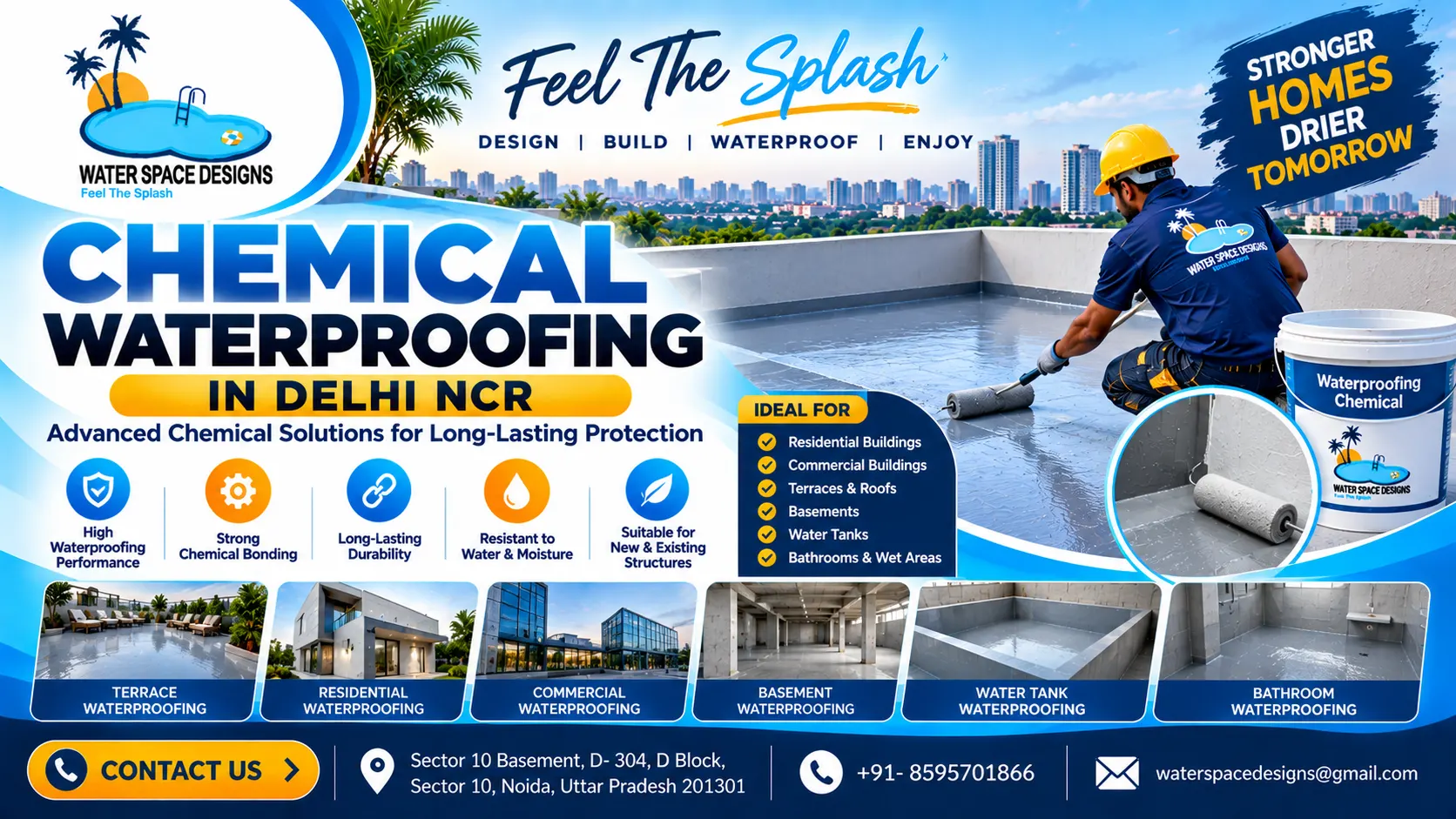
Water Space Designs provides professional chemical waterproofing in Delhi NCR for residential, commercial and specialized construction projects where protection against water penetration, leakage and moisture is required.
Chemical waterproofing can involve different types of liquid-applied, cementitious, polymer-modified, polyurethane and other specialized waterproofing systems. The appropriate system depends on the surface, water exposure, movement, existing condition and intended application.
There is no single chemical waterproofing product that is suitable for every structure. A terrace, swimming pool, bathroom, basement and concrete water-retaining structure can have completely different waterproofing requirements.
At Water Space Designs, our approach is to assess the application first and then recommend a waterproofing system appropriate to the project.
Professional Chemical Waterproofing Services in Delhi NCR
Chemical waterproofing solutions can be considered for:
- Terrace waterproofing
- Roof waterproofing
- RCC roof waterproofing
- Swimming pool waterproofing
- Bathroom waterproofing
- Balcony waterproofing
- Concrete structure waterproofing
- Wet-area waterproofing
- Water-retaining structures
- Construction joint treatment
- Crack treatment
- Pipe penetration treatment
- Leakage and seepage treatment
- New construction waterproofing
- Waterproofing renovation
- Existing structure waterproofing
The actual waterproofing system should be selected according to the substrate, exposure and project requirements.
What Is Chemical Waterproofing?
Chemical waterproofing generally refers to the use of specially formulated waterproofing compounds, coatings, membranes, admixtures or related systems designed to reduce or prevent water penetration through construction surfaces.
Depending on the application, chemical waterproofing may involve:
- Cementitious coatings
- Polymer-modified coatings
- Elastomeric systems
- Polyurethane-based systems
- Liquid-applied membranes
- Crystalline waterproofing systems
- Waterproofing admixtures
- Other application-specific chemical systems
These systems can have different properties and should not be treated as interchangeable.
For example, government waterproofing guidance lists cementitious elastomeric coatings among applications for swimming pools and water-retaining structures and PU-based waterproofing among applications for roofs, terraces and podiums. RDSO Indian Railways
Why Is Chemical Waterproofing Important?
Water can enter a building through cracks, porous surfaces, joints, construction interfaces and poorly detailed penetrations.
If water penetration continues, it may contribute to:
- Dampness
- Ceiling stains
- Paint deterioration
- Plaster damage
- Efflorescence
- Surface deterioration
- Recurring leakage
- Damage to interior finishes
Chemical waterproofing can form a protective layer or provide a specific water-resistant mechanism depending on the selected system.
However, waterproofing material alone cannot correct every underlying construction problem. Drainage, cracks, joints, structural movement and surface preparation also need appropriate attention.
Chemical Waterproofing for Terraces
Terraces experience direct exposure to rainfall, sunlight and temperature changes.
Chemical waterproofing can be considered for terraces where a liquid-applied or coating-based system is appropriate.
Before application, important factors include:
- Surface condition
- Existing waterproofing
- Cracks
- Terrace slope
- Drainage
- Water ponding
- Parapet junctions
- Pipe penetrations
- Existing surface finish
A recent Delhi NCR market guide notes that chemical or liquid coatings are commonly used where the terrace is relatively sound and the substrate can be properly prepared, while membrane systems may be more appropriate for other conditions. XpertWorker
The correct system should therefore be selected after assessing the actual terrace.
Chemical Waterproofing for Roofs
Roof surfaces can develop leakage because of cracks, weather exposure, poor drainage, damaged waterproofing or vulnerable construction details.
Chemical waterproofing systems may be suitable for certain roof applications, particularly where a seamless liquid-applied solution is appropriate.
Potential treatment areas include:
- RCC roof slabs
- Roof cracks
- Pipe penetrations
- Drain outlets
- Parapet junctions
- Construction joints
- Roof-to-wall interfaces
The system must be compatible with the substrate and expected environmental exposure.
Chemical Waterproofing for Swimming Pools
Swimming pools are continuously exposed to water, so waterproofing must be carefully integrated into the pool construction.
Chemical waterproofing systems may be used for appropriate pool applications, depending on the structure and finishing system.
Important areas include:
- Pool floor
- Pool walls
- Corners
- Construction joints
- Steps
- Pipe penetrations
- Drains
- Pool fittings
Waterproofing selection should consider continuous water exposure and compatibility with the final pool finish.
Chemical Waterproofing for Bathrooms and Wet Areas
Bathrooms and other wet areas can experience repeated exposure to water.
Waterproofing may be required around:
- Bathroom floors
- Shower areas
- Wall-floor junctions
- Pipe penetrations
- Floor drains
- Plumbing fixtures
- Corners
Proper detailing around plumbing penetrations and junctions is particularly important because these areas can become potential pathways for water.
Chemical Waterproofing for Concrete Structures
Concrete is not automatically completely impermeable to water. Cracks, joints, pores and construction interfaces can provide pathways for moisture.
Chemical waterproofing may be considered for suitable concrete structures, including:
- RCC slabs
- Concrete tanks
- Water-retaining structures
- Concrete walls
- Wet areas
- Certain underground structures
The selected system must be appropriate for the exposure and intended use.
Chemical Waterproofing for New Construction
New construction provides an opportunity to incorporate waterproofing into the building process before finishes are installed.
Chemical waterproofing can be considered at appropriate stages for:
- Terraces
- Roofs
- Bathrooms
- Balconies
- Swimming pools
- Water-retaining structures
- Other wet areas
Early waterproofing planning can help ensure that joints, penetrations, corners and drainage interfaces are addressed before they become concealed by finishing materials.
Chemical Waterproofing for Existing Buildings
Existing structures require additional assessment because the cause of leakage may not be immediately visible.
Before applying a chemical waterproofing system, it may be necessary to evaluate:
- Existing coating
- Surface cracks
- Dampness
- Water-entry points
- Drainage
- Joints
- Pipe penetrations
- Surface strength
- Previous repair work
If the existing substrate is unsuitable, surface preparation or removal of damaged material may be necessary.
Chemical Waterproofing Methods
Different chemical waterproofing technologies serve different purposes.
Cementitious Waterproofing
Cementitious systems are generally applied to suitable concrete or masonry substrates.
They can be considered for applications such as:
- Wet areas
- Concrete structures
- Water-retaining structures
- Swimming pools
- Certain below-grade applications
Their suitability depends on the substrate and exposure conditions.
Polyurethane Waterproofing
Polyurethane-based systems can provide flexible waterproofing layers and may be considered where movement and crack-bridging characteristics are important.
They can be used for appropriate roof and terrace applications, subject to product specifications and site conditions.
Polymer-Modified Waterproofing
Polymer-modified systems can improve certain performance characteristics of conventional cement-based waterproofing.
Their use depends on the intended application and manufacturer’s technical requirements.
Crystalline Waterproofing
Crystalline systems are designed to reduce water penetration through suitable concrete structures using a chemical reaction within the cementitious matrix.
They may be considered for particular concrete and water-retaining applications where the system is technically appropriate.
Liquid-Applied Waterproofing
Liquid-applied waterproofing systems can create a continuous coating when properly applied.
They can be useful around complex details and penetrations where a seamless liquid membrane is appropriate.
Chemical Waterproofing Process
Water Space Designs follows a structured process rather than applying chemical waterproofing directly over an untreated surface.
1. Site Inspection
The affected structure is inspected to understand the surface condition and water-related problem.
2. Leakage Assessment
The likely source and pathway of water penetration are evaluated.
3. Substrate Assessment
The surface is checked for cracks, loose material, contamination, existing coatings and other conditions.
4. System Selection
An appropriate chemical waterproofing system is selected according to the application and project requirements.
5. Surface Preparation
The substrate is prepared according to the requirements of the selected system.
6. Crack and Joint Treatment
Relevant cracks, joints and vulnerable transitions are treated using suitable methods.
7. Chemical Waterproofing Application
The selected waterproofing material is applied according to its technical requirements, including specified coverage and application stages.
8. Detailing
Corners, drains, pipe penetrations, joints and other vulnerable areas receive appropriate attention.
9. Inspection and Testing
Where appropriate, the completed waterproofing is inspected or tested before the area is returned to service.
10. Protective Finish
Where required, a compatible protective layer, screed, tile or other final finish is installed.
Why Surface Preparation Matters
Surface preparation is one of the most important parts of chemical waterproofing.
Even a technically suitable waterproofing material can perform poorly if the substrate is not properly prepared.
Preparation may involve:
- Cleaning the surface
- Removing loose material
- Removing unsuitable coatings
- Repairing cracks
- Treating joints
- Repairing damaged concrete
- Preparing corners
- Addressing moisture conditions
- Creating suitable surface texture
The exact preparation procedure depends on the waterproofing system being used.
Chemical Waterproofing and Crack Treatment
Waterproofing should not be used as a substitute for structural crack repair.
Cracks may result from:
- Shrinkage
- Thermal movement
- Settlement
- Structural movement
- Construction conditions
- Surface deterioration
The type, width, location and cause of the crack should be evaluated before deciding how it should be treated.
Chemical Waterproofing Around Joints and Penetrations
Waterproofing failures can occur at transitions between different construction elements.
Special attention may be required around:
- Construction joints
- Movement joints
- Pipe penetrations
- Drain outlets
- Wall-floor junctions
- Parapets
- Equipment supports
- Pool fittings
A continuous waterproofing detail should be created wherever the selected system requires it.
How Much Does Chemical Waterproofing Cost in Delhi NCR?
There is no fixed chemical waterproofing rate for every project.
The cost can depend on:
- Area
- Surface condition
- Waterproofing system
- Number of coats
- Surface preparation
- Crack and joint repairs
- Existing waterproofing
- Accessibility
- Required protection
- Final surface finish
- Project location
- Material specification
Current Delhi NCR waterproofing market information shows substantial variation between liquid chemical coatings and heavier membrane systems, reinforcing the importance of comparing the actual scope rather than using one universal per-square-foot price. XpertWorker
A site inspection and itemized scope provide a more meaningful estimate.
How to Choose a Chemical Waterproofing Contractor
Before hiring a waterproofing contractor, ask:
- What is causing the leakage?
- Which waterproofing system is being proposed?
- Why is that system appropriate?
- What surface preparation is included?
- How will cracks be treated?
- How will joints and penetrations be detailed?
- Which technical specifications apply?
- How many application stages are included?
- Will testing or inspection be carried out?
- What warranty terms, if any, are provided in writing?
Do not select a waterproofing system solely because it is advertised as “chemical waterproofing” or because it has the lowest price.
Why Choose Water Space Designs?
Water Space Designs takes an application-specific approach to chemical waterproofing.
Our approach focuses on:
- Site assessment
- Leakage diagnosis
- Appropriate system selection
- Surface preparation
- Crack treatment
- Joint treatment
- Pipe penetration detailing
- Terrace waterproofing
- Roof waterproofing
- Swimming pool waterproofing
- Wet-area waterproofing
- New construction waterproofing
- Existing structure waterproofing
Our objective is to match the waterproofing system with the actual construction condition rather than treating every project with the same chemical.
Chemical Waterproofing for Residential Properties
Water Space Designs can assist with chemical waterproofing requirements for:
- Independent houses
- Villas
- Apartments
- Residential buildings
- Farmhouses
- Residential developments
Applications may include terraces, roofs, bathrooms, balconies, swimming pools and other suitable areas.
Chemical Waterproofing for Commercial Projects
Commercial properties can contain larger roof areas, equipment penetrations, service areas and complex construction interfaces.
Chemical waterproofing may be considered for suitable:
- Commercial roofs
- Terraces
- Wet areas
- Concrete structures
- Swimming pools
- Service areas
- Other water-exposed surfaces
The final system should be selected according to the property’s construction and operational requirements.
Chemical Waterproofing in Delhi NCR Locations
Water Space Designs provides chemical waterproofing solutions across major Delhi NCR locations, subject to site assessment and project requirements.
Chemical Waterproofing in Delhi
Chemical waterproofing solutions for suitable residential, commercial and specialized construction projects in Delhi.
Chemical Waterproofing in Noida
Waterproofing solutions for terraces, roofs, wet areas, concrete structures and other suitable applications in Noida.
Chemical Waterproofing in Greater Noida
Chemical waterproofing for new and existing construction projects in Greater Noida, subject to site assessment.
Chemical Waterproofing in Ghaziabad
Chemical waterproofing and leakage treatment solutions for suitable properties in Ghaziabad.
Chemical Waterproofing in Gurugram
Waterproofing solutions for residential, commercial and specialized properties in Gurugram.
Chemical Waterproofing in Faridabad
Chemical waterproofing services for suitable terrace, roof, concrete and wet-area applications in Faridabad.
Frequently Asked Questions
What is chemical waterproofing?
Chemical waterproofing refers to waterproofing systems using specially formulated compounds, coatings, membranes, admixtures or related materials designed for specific construction applications.
Is chemical waterproofing suitable for terraces?
It can be suitable for certain terraces, particularly where a liquid-applied or coating-based system is appropriate. The surface condition, drainage, movement and existing waterproofing should be evaluated first.
Which chemical is best for waterproofing?
There is no single chemical that is best for every application. Cementitious, polymer-modified, polyurethane, crystalline and other systems have different characteristics and suitable applications.
Can chemical waterproofing stop terrace leakage?
It can help prevent water penetration when the correct system is selected and properly applied, but the underlying source of leakage must also be addressed.
Is chemical waterproofing suitable for swimming pools?
Certain chemical waterproofing systems are designed for water-retaining structures and swimming pools. The selected system must be compatible with continuous water exposure and the pool’s construction and finishing system.
How long does chemical waterproofing last?
There is no universal lifespan. Performance depends on the product, application quality, substrate, exposure, movement, drainage, maintenance and site conditions.
Can chemical waterproofing be applied over old waterproofing?
Sometimes, but not automatically. The existing waterproofing must be assessed for adhesion, compatibility, damage and suitability. In some cases, removal or extensive preparation may be required.
Do you provide chemical waterproofing in Noida and Greater Noida?
Water Space Designs provides chemical waterproofing solutions across Delhi NCR, including Noida and Greater Noida, subject to site assessment and project requirements.
Get the Right Chemical Waterproofing Solution
Chemical waterproofing should be selected based on where it is being used, what is causing the water penetration and how the structure is expected to perform.
A terrace, swimming pool, bathroom and concrete water-retaining structure can require different waterproofing approaches. Proper diagnosis, surface preparation, system selection and detailing are therefore more important than simply choosing a waterproofing chemical by name.
If you are looking for chemical waterproofing in Delhi NCR for a terrace, roof, swimming pool, bathroom, concrete structure or leakage problem, contact Water Space Designs to discuss your requirements and arrange a site assessment.
Water Space Designs — Chemical Waterproofing Solutions for Delhi NCR.